Together, we can reduce barriers to a happy life!
Samaritas offers a holistic continuum of care to give Michiganders the best shot at a happy, healthy, and full life.
As Michigan’s ninth-largest nonprofit, we provide foster care, adoption, family preservation, affordable housing, and refugee resettlement services to people working hard to reclaim hope, help, and heal after experiencing some of life’s most challenging circumstances.
Through our support, clients get access to essential services to reduce social determinant barriers like the lack of affordable housing, food insecurity, inadequate education, and limited transportation, which can profoundly change the direction of their lives.
With new collaborations with businesses, community groups, and municipalities, we can enrich existing programs that reduce these barriers to well-being.

Your support can help us enrich existing Samaritas services and programs that:
Reduce Barriers to Housing
Our Neighbors Not Numbers campaign underscores the need for more affordable housing options for people from all walks of life. Your assistance can support:
- Housing options, rentals, and land for all our clients to reside.
- Multi-year support for required Global Refuge household goods that underpin our R&P refugee program.
- Multi-year support logistical support to help move refugees into new spaces.
- On-demand movers to help move refugees into new spaces.

Reduce Barriers to Employment
Samaritas partnerships with businesses connect employers to refugees who are trained and ready to work on day one.
Reduce Barriers to Education
- Family field trips for foster families.
- Shadow days and field trips to businesses, municipal organizations, and more help educate refugees about Michigan life.
- Funds to help young refugee students acclimate to public school life.
Learn more about the federal Refugee School Impact (RSI) program.
Barriers to Mental Health
- Foster parents need support to continue being superheroes to their foster kids. Multi-year partnerships can provide foster care support groups for foster parents in Detroit, Grand Rapids, Kalamazoo, Flint, Ann Arbor, and Jackson.
- Volunteers are needed to coordinate foster care support groups in Detroit, Grand Rapids, Kalamazoo, Flint, Ann Arbor, and Jackson.
- Samaritas offers art therapy to help the youngest refugees manage their feelings about their journey to Michigan. Art supplies can support the creative needs of our Refugee Youth Art Show.
- Funds could also expand art therapy to other Samaritas clients with behavioral health challenges.
Barriers to Transportation
- Partnerships and collaborations could provide on-demand transportation options to get foster kids and birth parents to required meetings.
- Business partnerships and collaborations could provide on-demand transportation options for refugees to get to required appointments.
- Volunteers are needed to drive clients to key meetings and appointments.
- Employers who can offer refugees transportation as part of a compensation package to attract/retain high-quality employees is also helpful.
What are social determinants of health?
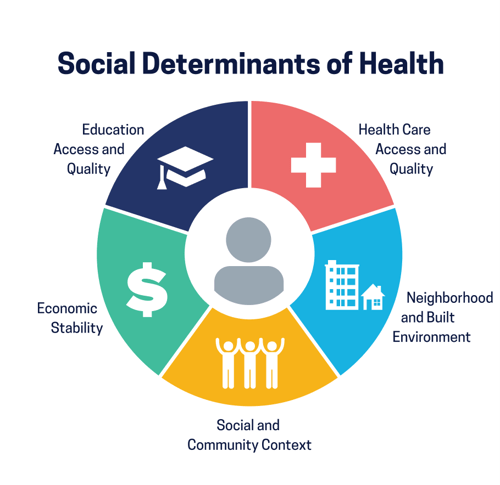
Social Determinants of Health (SDOH) are the conditions in which people are born, live, learn, work, play, worship, and age that affect a wide range of health, functioning, and quality-of-life outcomes and risks.
According to the U.S. Departments of Health and Human Services SDOH can be grouped into five domains.
It's not a secret.
Equal access to food, housing, education, and transportation is the key to a happy and fulfilling life.
We’re working daily to reduce these inequities and improve outcomes for families, foster kids, refugees, and individuals who need care and compassion.
Help us continue this work.